Musings
Breaking News, Building Newsrooms, Teaching the Craft: The Only Life I Knew
.jpg)
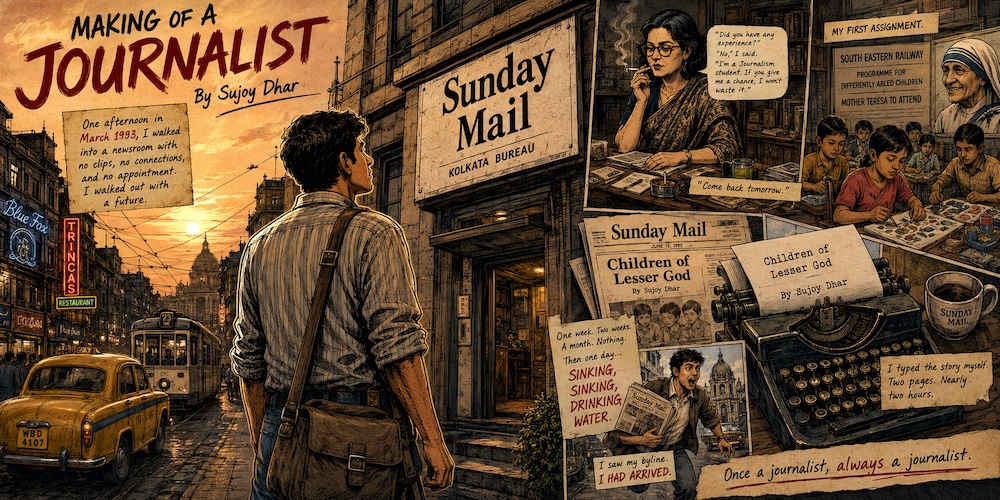
One day in March 1993 — I do not remember the date, but I remember the day with the clarity you reserve for the ones that change you. I was walking down Park Street, as I often did, aimlessly, just to soak in the place. Kolkata's sunset boulevard has a way of making you feel like the city is on your side. I had taken a left onto Rafi Ahmed Kidwai Road — the old Wellesley Street — heading toward the Calcutta University campus at College Street, when a signboard on a newly constructed building stopped me cold. Two words: Sunday Mail.
I stared at it for a while. Then I went in.
I climbed the stairs to a Spartan office and found a smart, nearing-middle-age woman who ran the Kolkata bureau of the weekly paper. "I want to write for your paper," I said, sweat on my face from the climb and from the sheer audacity of what I was doing.
I had no published work. None. Not even a school magazine piece. I had always told myself my debut would not be in some little journal — it would be somewhere real, where real journalists worked. And so here I was, gate-crashing an editor's table on nothing but that conviction.
She was not intimidating. She was not patronising either. She enjoyed her cigarette, took a long look at me, and asked me to sit. Did I have any experience? No, I said. I was a Masters student in Journalism at Calcutta University, but if she gave me a chance I would not waste it.
She asked me to come back the next day. When I did, she handed me an invitation from South Eastern Railway — a programme for differently-abled children, with Mother Teresa attending. My heart skipped. My first assignment, and it came with a Nobel laureate attached.
The day arrived. The aging PRO of SE Railway — Pratap Babu, whom I remember warmly and who is no longer with us — walked me into the sprawling SER campus at Garden Reach, where the Ganges bends along the city's western edge. The spring morning was bright, the river breeze generous. I felt, for the first time, like someone who belonged somewhere.
Mother Teresa did not come.
I pushed the disappointment aside. I spoke with the children, watched their paintings and handicrafts, took notes, collected quotes. The morning was spent well. But riding back, I kept thinking: without the star attraction, would the editor run anything at all?
I went to the Sunday Mail office the next day and told her everything. She didn't flinch. "You can still write a feature," she said. "Write about the children. Write about what SER does for them." That was all I needed. I left feeling like the city had handed me something.
I was learning to type then — reluctantly, at a typing school near my graduation college in Golpark — and computers were still a luxury most people didn't have. I typed the piece myself. Two pages took nearly two hours. Then I titled it Children of Lesser God — borrowed, yes, from the 1986 film, a headline as clichéd as they came — and typed my byline underneath: By Sujoy Dhar.
I've thought about that headline since. Clichés exist because they work, and knowing the worn paths of a profession is how you eventually find your own. I was more in sync with journalism's instincts than I realised.
I submitted the piece and was told it could take a fortnight if accepted. After that, every week, I would scan the pages of Sunday Mail at news stands across the city. One week. Two weeks. A month. Nothing. I stopped looking. I told myself it hadn't made the cut — either because Mother Teresa was absent, or because the writing was too green, or both.
Then one morning in the Calcutta University classroom, my friend — who now works with PTI, and who was, even then, the most enterprising journalist-in-waiting among us — looked at me with a knowing smile and said: "Sinking, sinking, drinking water."
I had no idea what he meant. Did he see me with some pretty young thing? I asked him.
He told me, after deliberate theatrical delay, that he had seen my byline in Sunday Mail.
I remember the sound the room made — which was nothing, because I kept my exclamation to a whisper on account of the teacher. But inside, something broke open. The story had been published after I'd stopped checking. I would later learn that a piece with any shelf life can sit on a page editor's desk for months, sometimes a year, before it finds its slot.
I left the classroom as soon as the period ended and walked — nearly ran — from College Street all the way to Dalhousie, where the outstation newspaper vendors set up by the Raj Bhavan gate (across it). I found two copies of Sunday Mail. I turned the pages until I found the article. I ran my fingers over the printed words. I looked at my name in print and felt something close to disbelief — and something close to love.
No one in my family had ever worked in mainstream journalism. I had no connections, no safety net, no one to put in a word. I had walked into a stranger's office on a March afternoon on nothing but nerve, and somehow, improbably, it had led to this. A byline. A beginning.
The next day I went back to the Sunday Mail office. The lady greeted me with a genuine smile — the kind that told me she too had not been entirely certain the piece would run, and was glad it had. "Your story has been published," she said, as though she was giving me news I hadn't already memorised.
Then she offered me another assignment. A new gym near the airport. A lifestyle piece. And then, in the same breath, a caveat: "You can write, but I cannot guarantee payment."
She paused, and said something I have carried with me every single day since.
"Journalism is a backbreaking job."
Later I found she worked in corporate communications at one of India's largest public sector companies. I have stayed in the profession she warned me about. She was right — it is backbreaking. It is rarely rewarding in the ways the world measures reward.
But if you are in it, truly in it, chasing stories with the same helpless urgency with which you once chased your first love — it becomes something else entirely. Something that transcends the grind, the late nights, the thanklessness of it.
The next few months were exciting too. Armed with my first byline — which meant something back then, a mainstream weekly newspaper clip — I approached a lady at the Financial Express office in Kolkata.
One sweltering summer day I walked into FE's Kolkata outpost, a paper with very little circulation in the city, but that Express brand mattered. I met Ranjita Biswas there, the features editor. She was arresting in a chiffon saree, elegant in the way only certain women are. I told her: this is my latest byline — conveniently hiding that it was also my first. Everything is fair in love and journalism when you're a rookie looking for a foot in the door.
She asked for ideas. I gave her a few: the craze for greeting cards, and the soft porn films running in the city's cinema halls. The film industry was in the doldrums. People had stopped going to big theatres. The VCR age and the gradual onset of cable TV had pushed hall owners to screen adult films made down south — no internet porn then — or interpolate clips into whatever they were showing.
She okayed both. I wrote, got published. When she later moved to The Telegraph, I followed and wrote for their special pages for years. Ranjita eventually left her job, went full-time freelance, and focused on writing and translation — work that earned her a Sahitya Akademi Award some years ago. But before that, we had decided to start a feature service together.
That is another story. She is family, and the years have settled on her — by a good two decades more than me — but we still run that small venture — a kind of extended feature arm of IBNS in the digital age, and my quiet tribute to a mentor.
It was at The Telegraph that I came under the orbit of Rajorshi Dasgupta — magnificent, dignified, and utterly unsparing. She was kind and loving in the way only the truly demanding can be, and she put every piece through a rigour that taught me more than any classroom. You did not just write for her. You grew.
The years that followed took me places I could not have imagined standing outside that building on Rafi Ahmed Kidwai Road. After working with one of India's two main wire services (read UNI), and then with IANS and Reuters, and as my bylines began appearing in Time magazine, Asiaweek, USA Today and publications across the world.
My few IANS years took me places — on the press plane with Prime Minister Manmohan Singh for a SAARC summit, or chasing the story of nuclear energy's quiet comeback in Scandinavia.
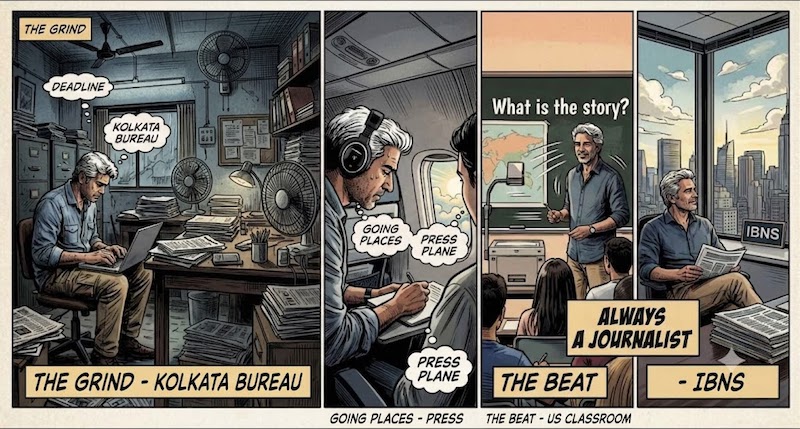
However, something in me still wanted more than a desk and a deadline someone else set.
At some point — alongside the wire work, alongside the foreign assignments, alongside the life of a working journalist that had by then become the only life I knew — I started building my own news organisations. From scratch, the way you build anything worth building: with more belief than resources and more stubbornness than sense.
Then came a decade and a half of teaching journalism in the United States, at institutions that rank among the finest in the world. The American chapter had its roots, oddly enough, in Kolkata — where I first met Laura Ungar, who had come to India on a fellowship, fell irreversibly in love with the country, and became the kind of Indophile who makes Indians feel their own land anew.
What began as a friendship became an academic partnership that has endured, the kind that crosses continents and outlasts institutions. I discovered that teaching the craft you love is its own form of reporting — every classroom a kind of beat, every student a story still being written. The questions were always the same ones I had carried since that March morning in 1993: what is the story, who does it serve, and are you skilled enough to tell it honestly.
Everything I have done — the wire service (read news agency) journalism, the magazine features, the editing, the building, the teaching — has been journalism in one form or another. The profession has shapeshifted around me and I have shapeshifted with it. But the thread has never broken.